💧 Give a well in the name of a loved one: a gift that flows forever.
🌳 Plant a tree today and reap rewards for eternity.
🎁 Looking for an unforgettable gift? Give a sadaqah jariyah in your parents’ name.
📖 “The best charity is giving water to drink.” (Narrated by Abu Dawud)
📖 “Charity never decreases wealth.” (Muslim)
📖 “Whoever plants a tree will be rewarded for every creature that benefits from it.” (Bukhari and Muslim)
Zakat is obligatory and has rules; sadaqah is voluntary and has almost none; lillah is a word British Muslims use for a voluntary gift that is not zakat. Three words, three different things, and a lot of confusion on donation forms. Here is the difference, in plain terms, and what it means for a water well.
In short
Zakat: obligatory, 2.5 % of qualifying wealth above the nisab, once a year, for eight categories of recipients (Qur’an 9:60). A pillar of Islam.
Sadaqah: any voluntary charity, any amount, any time, to anyone. Includes sadaqah jariyah, the kind that keeps giving.
Lillah: “for Allah”; in the UK, a voluntary donation that can be used for anything, including buildings. Not zakat.
A water well is sadaqah (and sadaqah jariyah). It is not zakat, and we never present it as such.
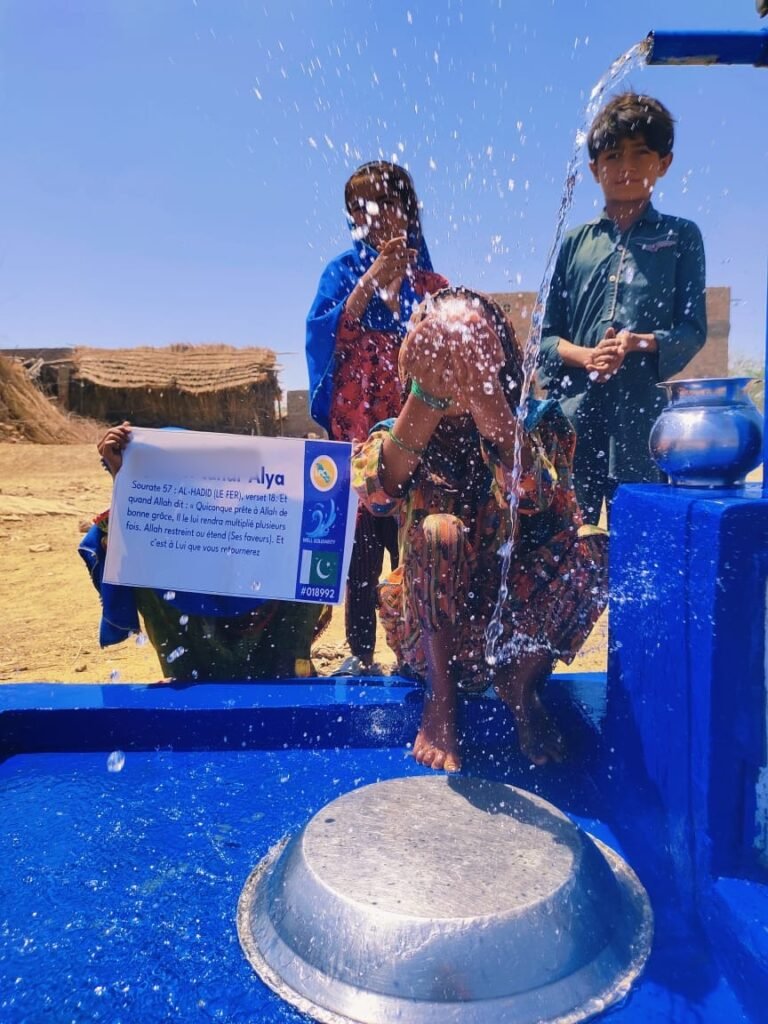
A plaque with Surah al-Hadid 57:18: whoever lends to Allah a good loan, it will be multiplied.
Zakat: the obligation
Zakat is the third pillar of Islam. Every adult Muslim whose wealth stays above the nisab (the value of 85 g of gold or 595 g of silver) for a lunar year pays 2.5 % of that wealth: cash, savings, gold, business stock, and certain investments. It is a debt owed, not a gift, and it must go to the recipients the Qur’an names.
“Zakat is only for the poor, the needy, those who collect it, those whose hearts are to be reconciled, for freeing captives, for those in debt, for the cause of Allah, and for the stranded traveller.”
Surah at-Tawbah, 9:60
Because zakat must reach these people, most scholars say it cannot be spent on construction: a mosque, a school, or a well is not one of the eight. Some organisations argue that a well “for the poor” falls under the first category; the majority view is that zakat should be given as ownership to the recipient, not as a building they share. If you want to be safe, pay your zakat to people, and build the well with sadaqah.
Sadaqah: the voluntary gift
Sadaqah is anything you give beyond zakat, for the sake of Allah: money, food, time, a kind word. There is no minimum, no maximum, no date, and no restriction on the recipient. The Prophet ﷺ said that charity does not decrease wealth (Sahih Muslim 2588), and that it extinguishes sin as water extinguishes fire (Jami’ at-Tirmidhi 614).
Hadith
“Charity does not decrease wealth, no one forgives but Allah increases him in honour, and no one humbles himself for Allah but Allah raises him.”
Sahih Muslim 2588, narrated by Abu Hurayrah.
Within sadaqah, scholars distinguish the one-off gift from the ongoing one. A meal is sadaqah; a well is sadaqah jariyah, because its benefit, and its reward, continue after you (Sahih Muslim 1631). The full explanation is in What is sadaqah jariyah?
Lillah: a British word for a simple idea
Lillah means “for Allah”. On UK donation forms it marks a voluntary gift that the organisation may use for anything: running costs, buildings, projects. It is sadaqah under another name, used to make clear that the money is not zakat and therefore not restricted to the eight categories. If a form offers “Zakat / Sadaqah / Lillah”, zakat is your obligation, and the other two are your choice.
The three side by side
Zakat
Sadaqah
Lillah
Obligatory?
Yes, a pillar of Islam
No
No
Amount
2.5 % of wealth above the nisab
Any
Any
When
Once a lunar year
Any time
Any time
Who receives it
The eight categories of 9:60
Anyone
Anyone, any purpose
Can it fund a well?
Majority view: no
Yes
Yes
Can it be given for a deceased person?
Only their unpaid zakat
Yes
Yes
Sadaqah al-fitr, fidya and kaffarah
Three other words appear on the same forms. Sadaqah al-fitr (zakat al-fitr) is a small obligatory amount, about the price of a meal, paid by every Muslim before the Eid al-Fitr prayer, to feed the poor. Fidya is paid by someone who cannot fast because of age or illness, one meal per day missed. Kaffarah is the expiation for a broken oath or a fast broken without excuse. All three are owed to people in need, like zakat; none of them should be spent on a well.
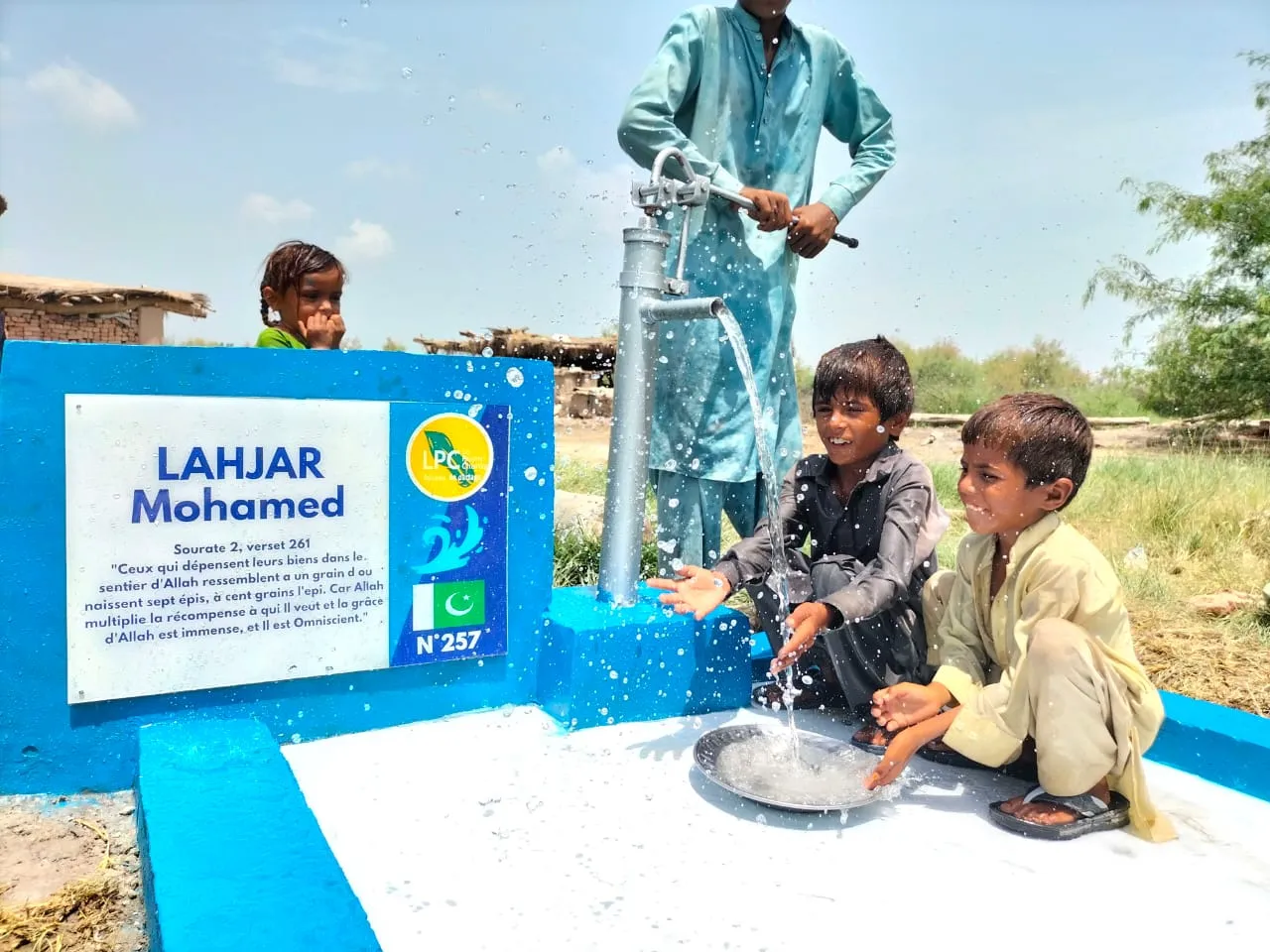
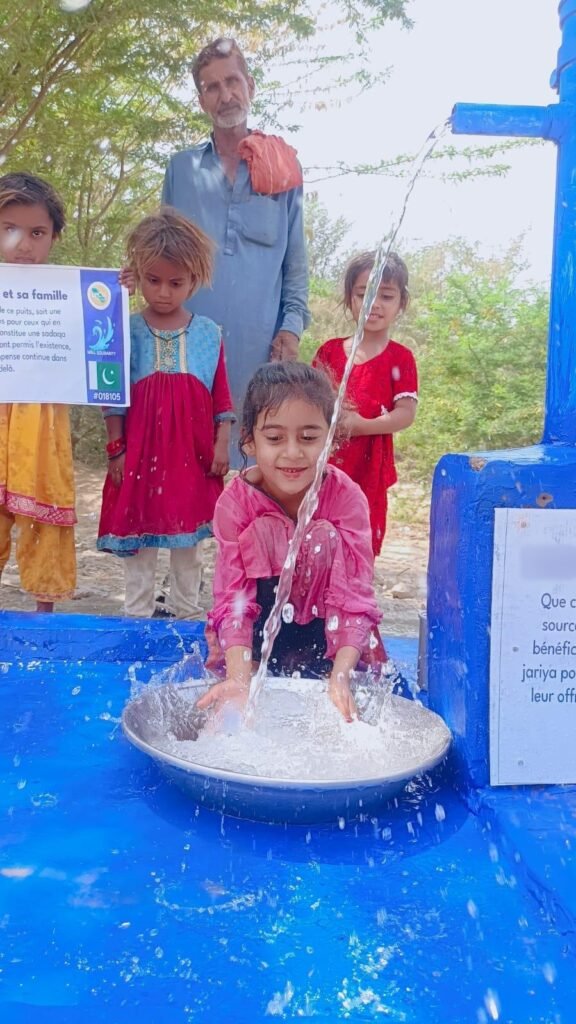
The first water of a hand-pump well in Sindh, Pakistan. The plaque with the customer’s name is held up for the photo you receive.
Sadaqah, in practice
Whatever the form says, the deed is the same: water, for years, in the name you choose. Pay zakat to people; build the well with sadaqah.
So, is a water well zakat or sadaqah?
Sadaqah. More precisely, sadaqah jariyah: a voluntary charity whose benefit continues. That is what makes it the right deed for a parent who has passed away, and the wrong place for your zakat. Well & Trees does not accept zakat and does not describe any product as zakat-eligible. Pay your zakat to people, then build the well. Read Is a water well sadaqah jariyah? for the texts, and How to calculate zakat to work out your obligation first.
Zakat is obligatory, 2.5 % of qualifying wealth once a year, for eight categories of recipients. Sadaqah is voluntary, any amount, any time, to anyone.
What does lillah mean?
“For Allah.” In the UK it marks a voluntary donation that an organisation may use for any purpose, including buildings. It is a form of sadaqah, not zakat.
Can I pay zakat for a water well?
The majority of scholars say no, because zakat must be given to the eight categories of people in 9:60, not spent on construction. Build the well with sadaqah and pay zakat to people. Well & Trees does not accept zakat.
What is the difference between sadaqah and sadaqah jariyah?
Sadaqah is any voluntary charity; sadaqah jariyah is the kind whose benefit continues, like a well or a tree, so the reward continues too.
Can zakat be given on behalf of a deceased person?
Only to settle zakat they owed and had not paid. Voluntary charity on their behalf, including a well, is sadaqah.
Sources
Qur’an 9:60 (recipients of zakat); 2:261.
Sahih Muslim 2588 (charity does not decrease wealth); Jami’ at-Tirmidhi 614 (charity extinguishes sin); Sahih Muslim 1631 (the three deeds).
Standard positions of the four schools on zakat and construction, as summarised by IslamQA (answer 122361) and SeekersGuidance.